International Law and Nuclear Weapons: Does the Continued Development of Advanced Nuclear Weapons Violate International Law?
By
2010, Vol. 2 No. 01 | pg. 1/1
KEYWORDS:
Since the beginning of the Cold War, nuclear weapons have played a crucial role in the international community, shaping the behavior of states and their actions in relationship to one another. Throughout the twentieth-century, nuclear weapons got deadlier; their range and power have both increased, bringing the potential for greater devastation to the globe. To limit the spread of nuclear weapons, the international community adopted the Non-Proliferation Treaty (NPT) in 1968, which calls for the secession of the nuclear arms race and abandonment of nuclear weapons. Recent American attempts to start research in the field of the low-yield nuclear bunker buster bombs brings important issues of legality of the proposed research in light of Article VI of the 1968 Non-Proliferation Treaty. Because the 2002 National Security Strategy does not prohibit this grade of weapons, the proposed research by the US military does violate international law because it is in contradiction to the Article VI of the NPT. It would continue the nuclear arms race between states, cause a severe humanitarian impact on the civilian population that reside in areas of the conflict, and would not lead to nuclear disarmament between the states, going in opposition to the established international treaties that aim to end the spread of the nuclear weapons. 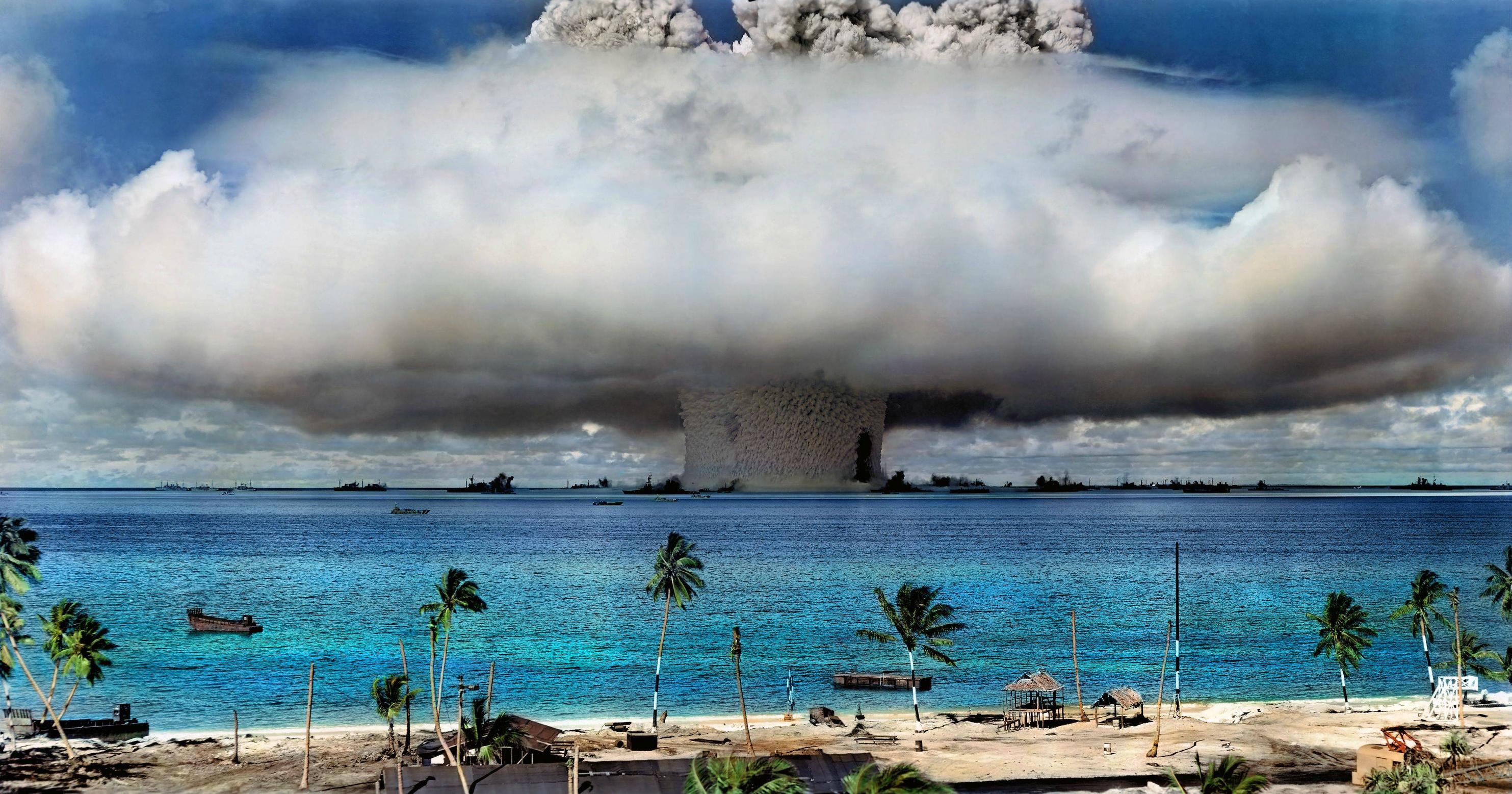
U.S. nuclear test near Bikini Atoll, Operation Crossroads, July 25th, 1946. Nuclear weapons are the most dangerous weapon ever created by man, built to insight fear in the enemy and to defend the borders of a particular state along with their national interests and zones of influence. The Non-Proliferation Treaty is one of the most important binding legal documents that curtails the spread of nuclear weapons and targets the future abandonment of the nuclear weapons. A recent proposal in the US to start appropriate research in the field of nuclear earth-penetrating weapons is a strong challenge to the treaty, because it contradicts the main provisions of the treaty, namely Article VI, which reads: “Each of the Parties to the Treaty undertakes to pursue negotiations in good faith on effective measures relating to cessation of the nuclear arms race at an early date and to nuclear disarmament, and on a Treaty on general and complete disarmament under strict and effective international control” (www.asil.org). The main reason that such a proposal is floating in the Pentagon, which is actively pushing for the research, is that it is a way to resolve a difficult problem of the destruction of the "hardened underground command bunkers and chemical or biological weapons sites that are otherwise inaccessible with conventional weaponry" (Alexander, 68). The issue here is that the creation of such weapons would perpetuate the ongoing nuclear arms race. If the US successfully developed a weapon of such kind, then other nuclear and non-nuclear bearing states would feel the necessity to have such weapons in their arsenal for better protection of their national interests and sovereignty. The goal of NPT and, especially Article VI, is to stop such races for the good of the humanity, because nuclear weapons are dangerous and pose threat to the population of the globe. Even though that the proposed research would create low-yield nuclear weapons, the crux of the problem is that it would be a step in the direction of the continuance of the nuclear arms race between the international actors, in violation of the NPT. Having experienced a number of local conflicts and two major world wars, the international community adopted the Geneva Convention in 1949 as a legal guideline for the appropriate measures of the conduct of the military conflict. The Geneva Convention is the base and the source of the international humanitarian law that deals with the conduct of war, usage of weapons during wartime, and treatment of civilians and military personnel. Bunker buster weapons are nuclear weapons the US has access to in times of conflict, which brings the same question: would the US use regular nuclear bombs in the process of conducting military warfare? The fallout from nuclear weapons can reach civilians in the area of the conflict, and innocent populations would be exposed to deadly radiation that leads to immediate death or severe diseases of internal human organs. Section I of the Additional Protocol I, Part IV, of the Geneva Convention, relative to the protection of civilian persons in time of war, states: “The second, in order to ensure respect and protection for the civilian population and civilian property, obliges the Parties to the conflict to distinguish at all times between the civilian population and combatants, as well as between civilian property and military objectives and to direct their operations only against military objectives” (www.icrc.org). When nuclear weapons are unleashed against a particular target, it becomes very difficult to achieve a mission without affecting the civilian population in the targeted area. The problem with nuclear weapons is that radiation can travel for thousands of miles and have a very significant humanitarian effect as well as deep ecological effects. Thus, the use of nuclear bunker busters would violate International Law, because it would breach one of the articles of the Geneva Convention on the matter of military warfare and treatment of the civilian population. In an advisory opinion of July 8, 1996 the International Court of Justice concluded that principles of humanitarian law do apply to nuclear weapons. The opposite conclusion "would be incompatible with the intrinsically humanitarian character of the legal principles in question which permeates the entire law of armed conflict and applies to all forms of warfare and to all kinds of weapons, those of the past, those of the present and those of the future" (www.icj-cij.org). According to the Court's opinion, any weapon that has the potential to harm must be limited in usage, due to the established practices and treaties of international humanitarian law. Nuclear bunker buster weapons are just another step in the future race of the creation of more powerful weapons in order to effectively protect the interests of the state and its national integrity and sovereignty. Living in an international community which has a number of nuclear possessing states and a wide range of nuclear capable states, it becomes crucial to control the spread of such weapons, due to the fact that they could get into the hands of terrorists or into the hands of a dictator, whose goal is the elimination of a particular group or a state by any means possible. If the US went ahead with the research of the bunker busters and created such a weapon, it becomes crucial to control and account for each of the weapons, so that they cannot get into the wrong hands. Otherwise, the introduction of new types of nuclear weapons would perpetuate the continuing trend to acquire nuclear materials by non-nuclear states for self-defense. One of the main reasons that non-nuclear states signed onto the NPT is that the nuclear states would assist them in exploring nuclear options only for peaceful usage. States now feel immense pressure to acquire nuclear weapons to gain respect, leverage, and power. Thus, the creation of the new type of low-yield weapons would perpetuate the continued flow of nuclear materials, weapons, and blueprints around the globe between the international actors, with the growing concern that states would abandon NPT and other treaties that have limited their behavior since 1968. Thus, it is essential for nuclear bearing states to lead the way in terms of nuclear disarmament and succeed in attempts to construct different types of nuclear weapons that would be tailored to a specific military task. The twentieth-century was one of the greatest centuries in human history in terms of events, discoveries and achievements, some of with were positive and a step forward in human development. One of the legacies of that century is nuclear weapons, the most powerful weapons ever produced, and so the greatest threat to the world community. Thus, the goal of the future needs to be the abandonment of nuclear weapons and secession of research in the scope of usage of nuclear material for military purposes. The world is under the threat of the uncontrollable spread of nuclear weapons and nuclear material. Nuclear states, such as the US, China, and Russia, must lead the way in setting expectations for the rest of the world, with the ultimate goal of erasing the words “nuclear weapons” from future history books. Works Cited Alexander, Brian, Alistair Millar. Tactical Nuclear Weapons. Dulles: Brassey's Inc, 2003. American Society of International Law. February 2005. ASIL. 12 December 2006. http://www.asil.org/insights/2005/02/insight050217.html International Court of Justice. July 1996. ICJ. 12 December 2006. http://www.icjcij.org/icjwww/idecisions/isummaries/iunanaummary960708.html International Comitte of the Red Cross. 12 December 2006. ICRC. http://www.icrc.org/web/eng/siteeng0.nsf/html/57JMJV 
From the Inquiries Journal Blog   Monthly Newsletter SignupThe newsletter highlights recent selections from the journal and useful tips from our blog. Suggested Reading from Inquiries Journal
Inquiries Journal provides undergraduate and graduate students around the world a platform for the wide dissemination of academic work over a range of core disciplines. Representing the work of students from hundreds of institutions around the globe, Inquiries Journal's large database of academic articles is completely free. Learn more | Blog | Submit Follow IJ


Latest in International Affairs |